Mobile DJ Load-In: What Nobody Tells New DJs
September 10, 2026
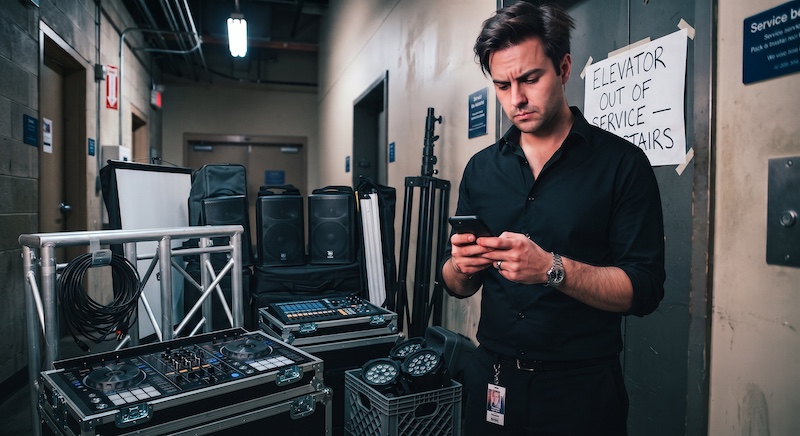
The gig posts always show the same thing: hands on the mixer, lights doing something moody, a crowd mid-cheer. Nobody posts the part before that — the forty-five minutes of stairs, the venue with exactly one working outlet on the wrong wall, the freight elevator that’s “usually fine.” That part doesn’t make the highlight reel, but it’s most of the job.
Set times get quoted in the contract. Load-in doesn’t. And that gap between “arrive at 6” and “actually playing music” is where most bad nights start — not during the set, before it.
The Timeline Nobody Writes Down
A load-in that looks easy on paper rarely is. Two cases and a controller can still take forty minutes if the loading dock is locked. The freight elevator needs a code nobody gave you. Or the room is being flipped from a rehearsal dinner and the tables aren’t cleared yet.
A useful starting point is to budget at least twice the time the physical carry seems like it should take. Add more for stairs, elevators, distant parking, security check-in, or any venue with “historic” in the description.
The part that actually eats time isn’t carrying gear — it’s the unknowns. Finding the right door. Finding whoever has the key to that door. Waiting for an elevator that’s shared with catering, who has twelve chafing dishes and zero interest in your schedule. None of that shows up on a set list, and none of it is optional.
What to Ask the Venue Before You Show Up
Most of load-in stress comes from information that was knowable a week earlier and just never got asked. A short list of questions before the event date saves more time than anything packed in the bag:
- Where can the vehicle be parked during load-in, and does it need to be moved immediately after unloading?
- Is there a loading dock, or does gear go through the front, and is that door propped or does someone need to let you in?
- Is there a service entrance closer to the DJ setup than the main entrance?
- Is there an elevator, and does it require a code, key, or staff escort?
- Are there specific load-in hours, security check-in requirements, or certificates of insurance needed?
- What time does the room actually become accessible—not the event start time, the room-clear time?
- How many outlets are near the DJ setup location, and are they on a dedicated circuit or shared with lighting and catering?
- Is there a house sound system already installed, or is everything being brought in?
None of these questions are unreasonable to ask a venue coordinator, and the ones who’ve hosted events before will usually answer in two sentences. The ones who can’t answer any of them are telling you something about how the day is going to go.
The Load-In Kit That Stays Packed
There’s a version of the load-in kit that lives permanently in the vehicle, gets touched maybe twice a month, and earns its space every time it’s needed. Contents worth keeping in it at all times:
- A hand truck or folding cart rated for the actual weight being moved, not the weight on the box
- Extension cords — at minimum one 25-foot and one 50-foot, both 12-gauge
- A power strip with surge protection, plus a spare
- Gaffer tape, not duct tape — it’s easier to remove cleanly and less likely to leave adhesive behind on floors, cables, and venue surfaces.
- Furniture sliders or moving pads for anything with a delicate finish
- A headlamp — phone flashlights don’t stay on hands-free
- Zip ties and a multitool
- A folded furniture dolly strap for stairs
The point of keeping this bag permanently loaded is that load-in problems don’t announce themselves in advance. The venue that swore they had extension cords on-site sometimes means “we had some, once, before someone borrowed them.” Carrying the redundancy removes the need to find out.
Stairs, Elevators, and the One-Outlet Room
Before unloading everything, walk the route from the vehicle to the setup location. One locked door, narrow turn, gravel path, or staircase can change which cart to use and how the cases should be stacked. Five minutes spent checking the route can prevent unloading the entire rig at the wrong entrance.
Stairs are the most common load-in problem and the least discussed one. A second-floor room with no elevator turns a single-trip load-in into three or four trips minimum. That math needs to happen before arrival, not on the stairs themselves. Breaking gear into carry-weight bundles ahead of time — instead of grabbing whatever’s closest to the door — saves real time on multi-trip load-ins.
Elevators introduce their own version of the same problem. A freight elevator that requires a building engineer to release it, or a passenger elevator shared with a wedding party in formalwear, both turn a five-minute ride into a wait. If the venue mentioned an elevator during the planning questions above, confirming who operates it removes one more unknown from the day.
The one-outlet room is its own category of problem. Older venues — restored barns, historic ballrooms, converted warehouses — were wired for lighting fixtures, not a full DJ rig plus uplighting plus a photobooth. Running a single circuit into a full setup trips breakers, and it usually happens mid-song. Ask the venue which outlets are on separate circuits, and never assume two nearby receptacles provide separate power. Distributing the system deliberately—and avoiding daisy-chained power strips—can prevent an overloaded circuit from producing a suddenly silent dance floor.
When It Goes Wrong Anyway
Even with every question asked and the bag fully stocked, something occasionally still doesn’t cooperate. The elevator really is broken that day. Or the venue coordinator who promised dock access left the company two weeks ago. Nobody told the new one. When that happens, the fix is rarely gear. It’s time management: knowing which pieces of the setup are truly first-priority for a functioning set, and which can be finished after doors open if the timeline gets compressed.
A reliable emergency order is simple: controller or mixer, laptop or primary music source, main speakers, and microphone first. Once the core system can play music and make announcements, add secondary speakers, lighting, façade, photobooth equipment, and everything else.
Practical Takeaways
Ask about docks, elevators, and outlets before the event date, not on arrival. Keep a dedicated load-in bag permanently stocked in the car. Budget triple the expected carry time for anything above ground floor or without direct door access. And when the day doesn’t cooperate, protect the core setup first and let the extras catch up once the room is open.
The crowd will never know whether load-in was easy or a complete mess. They’ll only know whether the music started when it was supposed to.