Mobile DJ Mic Technique: Sound Like You Belong Up There
August 20, 2026
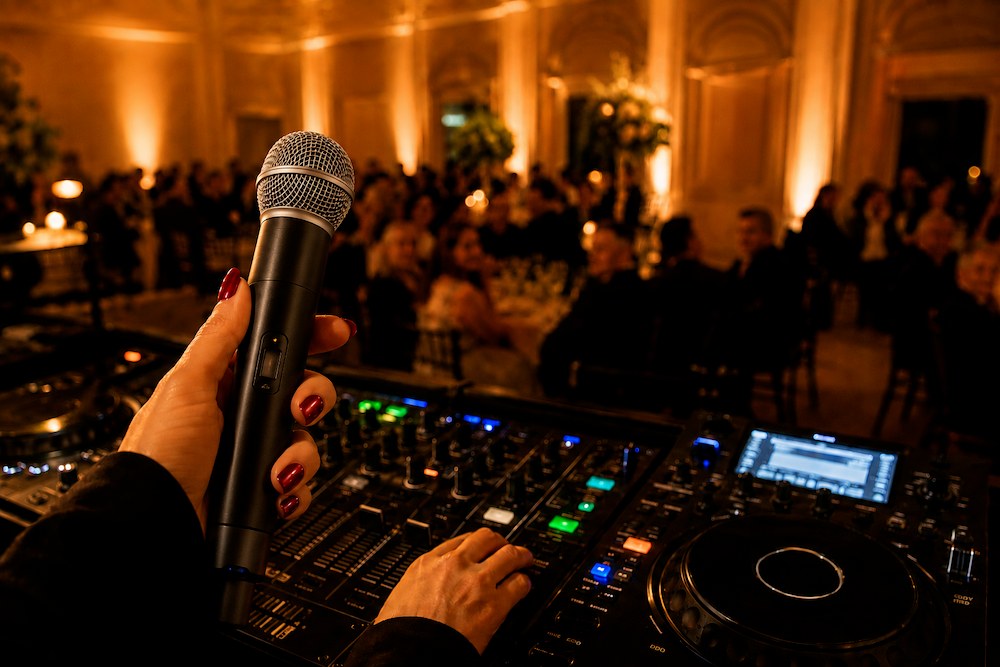
The room is fine until the mic opens.
A hundred and forty people, salad plates, that comfortable hum of twenty conversations happening at once. Then comes the first “Can I get everybody’s attention…” and the entire night turns on the next eleven seconds. Either the room quiets down and looks up, or it doesn’t, and the rest of the evening becomes a negotiation with a crowd that has already decided you’re background noise.
Mixing is a skill you can hide behind. The mic is not. It’s the one part of a mobile gig where there’s no crossfader to save you, no track to cut to, no “let the drop do the work.” Just a voice, a PA, and a room full of people who can hear every bit of hesitation.
Here’s the part that gets skipped in most DJ education: mic technique is mostly physics and structure, not charisma. Fix those two and the confidence shows up on its own.
You’re competing with the same speakers your voice comes out of
Feedback isn’t bad luck. It’s a loop — the mic hears the speaker, the speaker amplifies what the mic heard, and around it goes. Everything about mic placement is really about making that loop as quiet as possible so you can turn yourself up before it screams.
Two things control this more than any setting on the board.
Where the mic lives relative to the speakers. A cardioid mic rejects sound arriving from behind it. That rejection is the entire reason live vocals work at all.
Your mic should be behind the mains, not out in front of them, with their business end pointing away from you. On a small mobile setup, this is why the DJ who parks the tops on the same line as the booth spends the night fighting a ring at 2 kHz.
How close your mouth is to the capsule. Every time you double the distance between your lips and the mic, you give up roughly 6 dB — and you make it back by cranking the channel gain, which cranks the speaker bleed right along with it. Distance is expensive. Proximity is free gain.
If a room still rings before you’ve got useful volume, ‘ring out’ the mic during setup (gradually bring the gain up until you hear the first feedback frequency) during setup instead of during the first dance. Push the mic gain up until it starts to sing, notice what it’s singing (low honk is usually 200–500 Hz, piercing is usually 2–4 kHz), and pull a narrow cut there. Hold the mic the way you’ll actually hold it while you do this — ringing out a mic that’s sitting in a clip on the table tells you about the clip.
Then bring the gain back down and leave headroom. A mic that sits right on the edge at soundcheck won’t stay there. Once the room fills, the acoustics change and the background noise rises. A mic that was comfortable at soundcheck may suddenly need more level.
Get closer than feels right, then fix the boom
Most DJs hold the mic like it’s a chin rest — six or eight inches out, angled up, doing nothing. Get it to two or three inches, just off-axis so your plosives don’t hit the mic directly.
Close-miking a directional mic boosts the low end. That’s proximity effect, and it’s why DJs who eat the mic sound like they’re announcing a monster truck rally through a duvet.
A high-pass filter around 100 Hz is a good starting point. If the voice still sounds muddy, look around 200–400 Hz for a modest cut. If it needs more intelligibility, try a small boost around 3–5 kHz.
And stop cupping the grille. Wrapping a hand around it — the pose everyone learned from rap videos — physically blocks the rear ports that make a cardioid mic directional. Cup it and you’ve turned a nice directional vocal mic into a feedback antenna. There’s a reason it sounds worse the second someone does it.
Don’t kill the music. Duck it.
Cutting the music to silence before an announcement is the single most common mobile DJ reflex, and it works against you. Silence tells a room that something formal is coming, which makes people brace. It also leaves your voice completely naked — every “um,” every dry mouth click, all of it exposed.
Duck the music — pull it down enough that your voice sits clearly on top, but leave a music bed underneath. The bed does two jobs: it keeps the energy from flatlining, and it gives your voice something to sit against so small imperfections disappear. The test is simple — if you have to push your voice to get over the bed, the bed is too loud.
What plays under the announcement matters too. Something instrumental, or at least something whose vocal isn’t fighting yours in the same frequency range. Talking over a big sung chorus is asking two people to speak at once, and the room will follow neither.
Then bring the music back up under the last word, not after it. That overlap is what makes a mic break feel like part of the night instead of an interruption of it.
The announcement formula nobody writes down
Most bad announcements aren’t badly delivered. They’re badly ordered.
Watch what happens when a DJ says: “So, uh, the caterers have let us know that dinner is going to be served buffet style tonight and they’d like to go ahead and start with tables one through four, so if you’re at those tables you can head on over.”
By the time the instruction arrives, the room has already tuned out. Flip it:
Attention → action → reason.
“Tables one through four — you’re up. Grab a plate, the buffet is open on the left.”
Same information, front-loaded. The people it applies to hear their cue immediately, and everyone else knows within two seconds that this one isn’t for them.
The companion rule: one idea per mic break. Dinner, then cake, then last call. Not all three at once. Every extra idea in a single announcement makes the others less likely to stick, and you end up repeating yourself later anyway — which trains the room to stop listening the first time.
Short is not lazy. Short is respectful. Nobody at a wedding has ever wished the DJ talked longer.
Names are the whole job
You can nail every announcement all night and still be remembered for one thing: mangling the maid of honor’s name.
Get a phonetic sheet before the event. Not just a spelling list — an actual write-it-how-it-sounds sheet for every name you’ll say out loud. Wedding party, parents, grandparents, the officiant, the venue.
The insider version: ask the couple to send a voice memo of themselves saying every name on the list. Thirty seconds of audio removes all the guesswork about which cousin’s name has a silent letter, and it’s the kind of small ask that clients read as thorough rather than annoying.
If you do blow one, fix it once, cleanly, and move on. “Michael — apologies, Michaela — let’s hear it.” No dwelling, no joke about it, no second apology later.
The room forgets a quick correction. It remembers a DJ who spends thirty seconds being embarrassed on a live mic.
Handing the mic to a guest
Toasts are where mobile gigs go sideways, and the handoff is the control point.
Walk it over rather than letting someone come get it. Mute it during the handoff, show them where to hold it, and don’t let them wander away with it. A light hand still on the body lets you coach the position without saying anything, and it lets you take it back if things go where things sometimes go.
Then coach the one thing that matters: “Keep it right here, by your chin.” People instinctively drop the mic to chest height while they talk, and every toast that nobody could hear died exactly that way.
For anything long, put a mic on a stand. Nervous people wander, and a stand solves what a lecture never will.
Three things that get repeated and aren’t true
“You need a radio voice.” You need to be intelligible and warm. Clients hire the DJ who sounded like a friendly human on the phone, not the one doing a monster truck voice at a garden wedding.
“More reverb sounds professional.” A touch of reverb helps a dry voice sit in a mix. In a live ballroom the room is already providing reverb for free, and adding more turns consonants into soup. Start at zero and add only if it’s actually missing.
“Louder is clearer.” Past a certain point, more level just means more mush and more feedback risk. Clarity comes from EQ, proximity, and pacing — slowing down does more for intelligibility than another 3 dB ever will.
The one habit that fixes all of it
Record your mic breaks. Every gig.
Most mixers have a record out; a phone in a pocket works too. Then listen back in the car. It’s uncomfortable the first few times, and it is the fastest improvement loop available, because the gap between how you think you sounded and how you actually sounded is where all the fixable problems live. Filler words, rushing, trailing off at the end of sentences, the same three phrases used eleven times — none of that is visible from behind the booth in the moment.
This is also the part that pays. Mixing gets you booked once. Being the DJ who ran a room cleanly, said every name right, and kept things moving without making it about themselves — that’s what gets described to the next couple, and MC ability is a billable line on a mobile contract for exactly that reason.
Run-of-show for your next gig
- Set the mic upstage of the speakers, and ring out the room before doors.
- Two to three inches from the mouth, slightly off-axis, no cupping.
- HPF around 100 Hz, cut the 200–400 Hz mud, small lift at 3–5 kHz.
- Duck the music to a bed; never to silence. Bring it back under the last word.
- Attention → action → reason. One idea per break.
- Phonetic name sheet, ideally with a voice memo from the client.
- Wired backup mic in the case, always.
- Thumb on mute during handoffs; stand for long toasts.
- Record yourself. Listen in the car. Fix one thing next time.